
- What elements of marketing provide the best ROI?
- What role should the sales team be playing for best results?
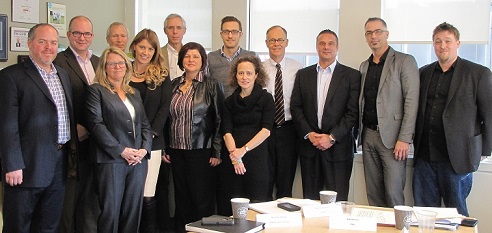
This ITAC/SMA Marketing & Sales Executive Think Tank was hosted at HighVail in Toronto, Ontario by Claude Reeves, Director, Enterprise Sales, Canada, Red Hat Canada. The discussion was moderated by Bob Becker, Principal, SMA.
Attendees
- Ray Deutschbein, Senior Enterprise Account Executive, Adobe Systems
- Douglas Long, Director, Strategic Marketing, Applanix
- Paul Gour, Managing Director – Toronto Region, ARC Business Solutions
- Tricia Santaguida, Marketing Programs Specialist, Asigra
- Emilie Rosen, Regional Marketing Manager, Business Development Bank of Canada
- Shannon Beattie, Marketing Manager, Eclipsys Solutions
- Michelle Rehak, Market Manager, Canada & US Federal, IBM Systems Group
- Caterina Didio-Duggan, Canadian Marketing Manager, Information Builders (Canada) Inc.
- Joe Kevens, Marketing Manager, Intelliware
- Michael Shulman, Manager, Canada Hardware and Technology Channel Sales-VAD, Oracle Corporation Canada Inc.
- Claude Reeves, Director, Enterprise Sales, Canada, Red Hat Canada
- Michael Smyth, Marketing Database Analyst, Softchoice Corporation
- Peder Enhorning, President & CEO, Unilytics Corporation
What We Learned
- Reduce direct marketing and conduct more face-to-face events.
- Leverage technology associations and consider other/smaller associations that feed into larger tradeshows.
- Conduct your own event and consider becoming an industry leader instead of spending your company’s top dollar at someone else’s event.
- Define success and engage the sales/marketing teams early in campaign planning.
- Include a lead-nurturer individual; avoid having one person to be everything in sales.
- Conduct roundtable forums to share common pains, validations and successes.
- Implement strong tracking systems from the outset once implemented, errors and bad habits are difficult to change.
- Develop a strong communication plan with multiple touch-points throughout the campaign.
- Consider engaging users first, instead of C-level to develop awareness; work your way upwards to the C-level.
- Question attending tradeshows with a free entry; analyze its target market and value to you before attending.
- Create smaller and more intimate groups between sales and marketing team members; make the sales team a marketing client.
- Measure ROI at different stages of the campaign to measure success and identify where improvement is needed.
- Tap into emerging technology; read about OpenStack, which was a good idea that got big (holding many small-scale meetings over the course of 5 – 6 years).
What marketing activities are you doing more of in the last few years and why?
- Conducting more face-to-face events, such as attending trade shows or hockey games.
- Conducting smaller/more intimate events to have face-to-face conversations and better engage with thought-leaders.
- Small events and large events still work well; but mid-sized events seem to be dying.
- Event type and marketing activities are determined by size and location of city (VAN, CAL, TO, MTL), and rural versus non-rural locations; In large cities, face-to-face events are challenging; whereas in rural areas or smaller cities, there is greater attendance and direct mailers and outbound calls are well received.
- Attending trade shows to organize side events such as a luncheon or dinner.
- Conducting sales-pitch events to get like- minded individuals together.
- If organization is small and unknown in the industry, organize more webinars to target users.
- Digital marketing is growing and used mostly to create awareness.
- Using LinkedIn more; however it may be more challenging to find and target the correct market.
What marketing activities are you doing less of in the last few years and why?
- Doing fewer traditional email campaigns due to CASL (not a lot of budget savings but saves in production efforts).
- Doing fewer large-scale trade shows as the entire model is challenged from obtaining speakers, to attending, to sponsoring.
- Avoiding tradeshows with a free entry; it’s just not the right target market, many users and students, no decision-makers.
- Marketing activities depend on the offering and what works best to influence market.
- Focusing on emerging, smaller technology trade shows; these types of trade shows are early in the cycle and are growing.
- Generating less content that is “about us” and instead are developing content that is actually informative and helpful to a prospective client.
- There is less interest in discussing product offering, including less formal white papers.
- Avoid generating light-weight pithy content it may affect the perception of your organization’s proficiency.
- Conduct less broad-based marketing campaigns as more focused and targeted activities work better.
- Analyze successes in order to repeat them and reduce incidences of unsuccessful activities/events.
How to leverage relationships with clients that are association members, such as ITAC?
- Keep them on the radar.
- Spend some of your marketing budget on nurturing these relationships.
- Understand the association and contribute to it – make the relationship valuable to both you and your contact.
SMA’s research says that tracking ROI is critical to high-tech marketers. What are the most effective ways to track ROI? How do you ensure that the sales team(s) updates the CRM?
- CRM updates from sales teams do not work; representatives need to follow up and this is a constant challenge.
- Ask yourself if it’s worth it to measure every lead. The smaller organizations are easier to manage; the larger ones are challenging.
- Don’t give a choice to sales team members with CRM updates if you are part of a small/medium-sized organizations; this way you can easily identify where the lead originated.
- Large organizations have many internal politics and its fast-paced momentum is their worst enemy.
- Proper and stringent CRM implementation is the key; be diligent and specific with rules and training.
- Make the CRM tool automated and easy to use, not manual; ensure the tool is aligned with sales objectives.
- Consider developing a control group for one campaign; measure, compare and show the differences.
- Tracking at a tactical level is challenging because identifying the first touch-point is challenging making it unable to measure.
- Sales find it counter-productive to enter into CRM until a sizeable deal is in place.
- Without a strong tracking technology it will be difficult to measure marketing campaigns.
- Is there even any real return on the time and effort spent in tracking?
What are the best practices for engaging the sales team in marketing initiatives to ensure follow-up on sales opportunities?
- Define “lead” with sales and marketing teams, ensure buy-in for “rules of engagement” and get agreement on how follow-ups will occur.
- Marketing needs to understand sales and help identify opportunities. This includes educating the sales team on what to focus on and present options.
- Have marketing teams consistently follow up with sales on a regular basis, i.e. weekly or monthly.
- Have marketing consider a mindset in which the sales team is their customer.
- Before a campaign begins, form a committee involving sales and marketing to look for feedback and input on qualified leads.
- Assess your organization’s culture; this is critical in understanding how sales and marketing interact.
- Define the criteria for success NOW so three months later you will have the benefit of hindsight –“did we deliver?”– aside from just the sale.
- Increase campaign communication — it should be at all stages, the beginning, middle and end. Your deliverables and focus will change at each stage leading to better results.
- In smaller organizations, the sales team is absolutely more engaged and desperate for leads and initiatives.
- Conduct persona building: who are they, how would they like to be contacted; based on this, build your campaign.
- Measure campaign metrics at different stages, including before it closes.
- Appoint strong individuals to focus and nurture leads; this can work but can be challenging; don’t expect sales to do everything, e.g. nurture the lead, put out fires, follow up, and deliver on sales.
- One person in Marketing should act as the bridge between field Sales and the production department in Marketing, but the strategy needs to be developed by the field sales team.

Technology Marketing
& Sales Group