

- What is the Canada’s Anti-Spam Legislation (CASL) and how will it affect my organization?
- What will I have to stop doing, and what will I have to start doing in order to comply?
This ITAC/SMA Tech Marketing & Sales Executive Think Tank was hosted at Softchoice Corporation in Toronto, Ontario by Bryan Rusche, Manager, Channel & Solutions Marketing. The discussion was moderated by Bob Becker, Principal, SMA.
Attendees
- Tricia Santaguida, Marketing Programs Specialist, Asigra
- Stuart Young, Vice-President, List Management and Data Products, Cornerstone Group of Companies
- John Millar, President, Digital Boundary Group
- Luis Paveloski, Marketing Manager, Canada, Hitachi Data Systems
- Caterina Didio-Duggan, Canadian Marketing Manager, Information Builders (Canada) Inc.
- Micheline Lepage, Manager, Programs and Events, ITAC
- Amanda Brown, Field Marketing Specialist, NetApp
- Selda Uzunmehmetoglu, Field Marketing Manager, SAS Institute (Canada) Inc.
- Stephanie Caron, Director, Strategic Planning, SMA
- Emily Davidson, Marketing Production Lead-ESSN, Softchoice Corporation
- Justin De Haan, Supervisor, Client Insight, Corporate Marketing, Softchoice Corporation
- Bryan Rusche, Manager, Channel & Solutions Marketing, Softchoice Corporation
- James Compton, Business Development, Solium
- Anu Vijh, Channel Marketing Manager, Canada, Symantec Corporation
- Aashti Vijh, Independent
What We Learned
- With the new upcoming legislation, consider going back 30 years to how sales used to be conducted; pick up the phone!
- There is a lot of information available regarding CASL, but there is still a lot confusion in the marketplace
- It is likely we will see an explosion in direct mail
- Consider standardizing email communication to obtain positive/opt-in consent
- There is a three-year window to convert opt-out consent to opt-in consent
- CASL may create additional issues between Marketing and Sales regarding how to deal with obtaining opt-in consent
- We are all guilty of spamming – we need to be smarter and deliver more valuable information to reduce complaints
- Organizations will need to look into their software cookies to ensure compliance with the new law
What is CASL?
It is “Canada’s Anti-Spam Legislation”, designed to eliminate unwanted Commercial Electronic Messages (e.g. emails) and to make the installation of unwanted software on your computer (e.g. “Trojan Horse” viruses) illegal. The big difference is that Opt-out consent will no longer be sufficient; it must be a positive/opt-in consent.
What is a Commercial Electronic Message (CEM)?
It is “Canada’s Anti-Spam Legislation”, designed to eliminate unwanted Commercial Electronic Messages (e.g. emails) and to make the installation of unwanted software on your computer (e.g. “Trojan Horse” viruses) illegal. The big difference is that opt-out consent will no longer be sufficient; it must be a positive/opt-in consent.
CASL does not apply to the following organizations:
- Messages sent by or on behalf of charitable organizations for fundraising.
- Messages sent by a political party, organization or candidate soliciting contributions.
- Members of a club or association sending messages to other members.
- Closed systems such as online banking sites.
CASL does not apply to the following situations:
- Messages sent within an organization, e.g. within a company or between company offices;
- Between organizations that have a relationship, e.g. a supplier and a customer;
- To satisfy a complaint;
- To respond to an inquiry;
- To satisfy a legal obligation;
- Between family members or those who have a personal relationship;
- Third Party referrals
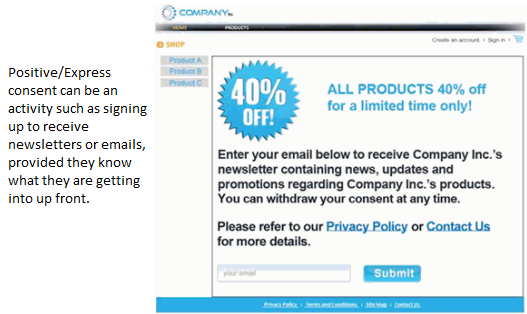
How do I get the express consent needed?
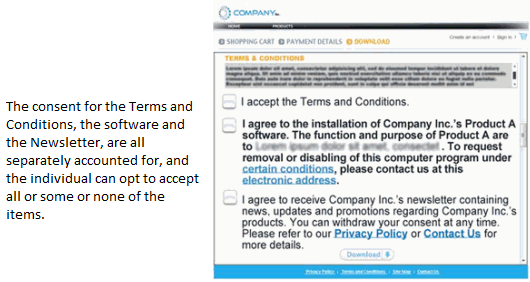
They have to be separate, in that you cannot “bundle” consents together, e.g. you cannot make consent tied to buying software or entering a contest. The following shows an example of an acceptable consent form.
All Commercial Electronic Messages under CASL must:
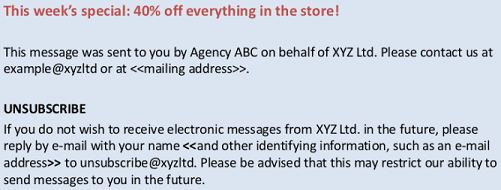
- Identify who sent the message and identify who the message is sent on behalf of
- Provide contact information for both of the above, including a snail mail address;
- Include an unsubscribe mechanism
- The addresses and the unsubscribe mechanism, must be good for at least 60 days after the message is sent.
The following is a definition of an unsubscribe mechanism:
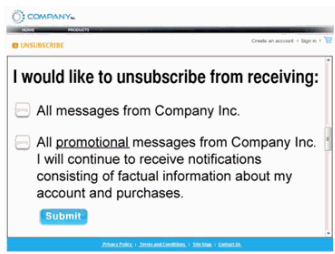
- Must be by the same electronic means as the CEM.
- If that’s not practical (such as in an SMS text), then by other electronic means and a web address.
- It must be included in every message sent.
- It must be at no cost to the receiver.
- If the receiver unsubscribes, you must ensure that no further messages are sent to the receiver within 10 business days
In order to ensure that you are compliant, you have to:
- Have proper consent
- Be able to prove that you have proper consent (keep track of when and where you got the consent)
- Manage requests to unsubscribe
- You must keep track of how the consent was acquired:
- For express consent, that means one or a combination of:
- Electronic database
- paper records,
- Audio files
- Or other means of recording the time, data, circumstance of the active permission of the receiver
What is defined as an existing business relationship?
In the two years prior to the sending of the CEM, the recipient had:
- Purchased or leased or bartered a product, goods, a service, land or an interest or right in land from the sender,
- Accepted a business, investment or gaming opportunity offered by the sender,
- A written contract is created between the recipient and the sender for a matter not listed above, or
- Six months before the message is sent, the sender received from the recipient an inquiry or application about one of the items above.

Technology Marketing
& Sales Group